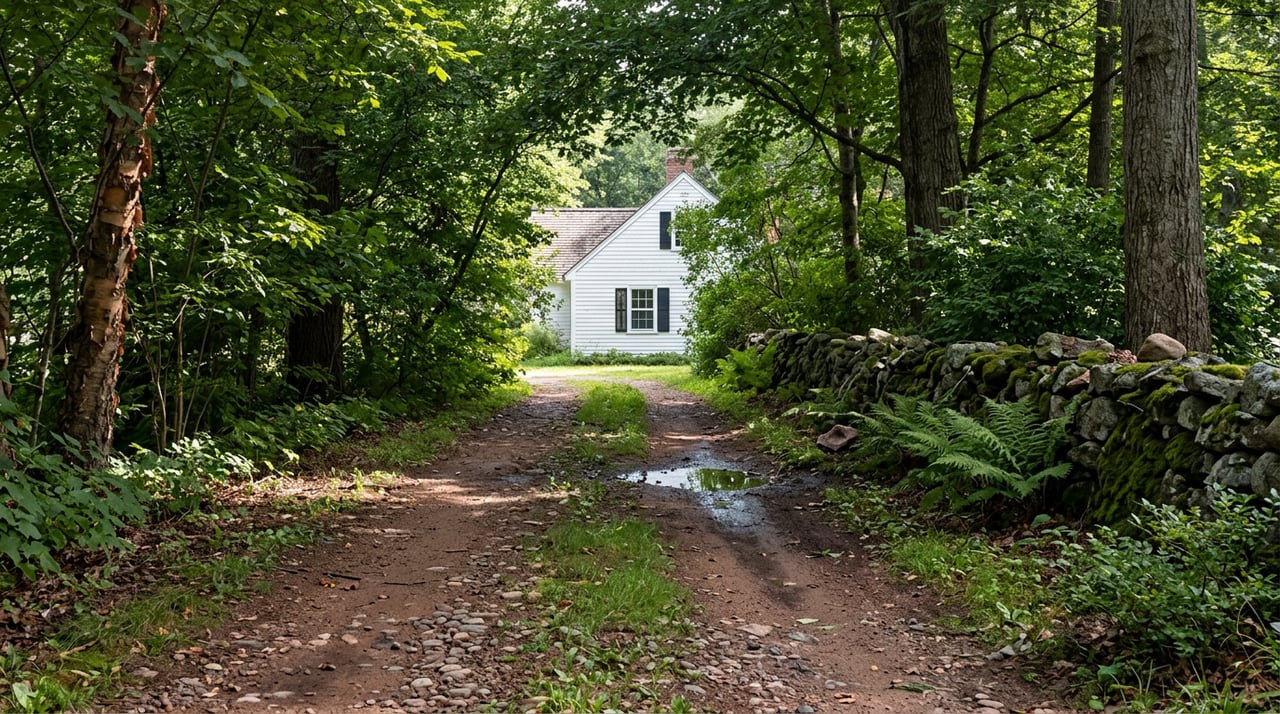
In August 2024, the Sandwich Board of Selectmen sat down with Road Agent Ty Bryant to sort out something that had been unresolved for forty years. Back in the 1980s, the town had reclassified the upper and lower loops of Bennett Street from a Class VI road to a Class V road, and it had done that as a condition of a conservation easement the property owners had granted. Four decades later, the town and those owners were still working out exactly what the reclassification obligated the town to maintain.
That meeting is not a curiosity. It is the clearest illustration you will find of how land actually gets valued in Sandwich, and it is the reason a buyer comparing this town to Meredith or Holderness on price-per-acre alone is missing the number that matters most.
The Acreage Isn't the Product. The Road Frontage Is.
New Hampshire law does not let a town issue a building permit for a lot unless the road giving access to it is a Class V highway or better, meaning a road the town has agreed to plow, grade, and maintain. Anything below that, a discontinued public road or a private way, falls outside that guarantee. State statute describes a Class VI road plainly as a public road that has been discontinued as an open highway and made subject to gates and bars, and until recently, getting permission to build on one meant a discretionary approval from the town's governing body, usually after a planning board review that could go either way from one town to the next.
Sandwich has a lot of these roads, and it has a lot of large, wooded, view-oriented parcels that sit on them. That combination is exactly why the Bennett Street precedent exists. It is also why a beautiful 40-acre listing at the end of a dirt lane can be worth dramatically less than an identical parcel a quarter mile away on a road the town actually maintains, regardless of what either one lists for per acre.
The Rule Changed on July 1
This year, the calculus shifted. Under Chapter 256 of the 2025 New Hampshire Laws, the state removed the requirement that a town's selectmen pre-approve a building permit on a Class VI road. As of July 1, 2026, that discretionary hearing is gone. In its place, an applicant now has to sign a waiver acknowledging the town will not maintain the road, provide services to the lot, or accept liability for anything that follows from that lack of services, record that waiver at the registry of deeds before a permit is issued, and demonstrate the lot and any structures on it are insurable before that permit is issued.
Private roads went through a parallel change the year before. Since September 13, 2025, each municipality has had to choose between leaving private-road approvals to case-by-case selectmen decisions or adopting a formal written policy that lets an applicant qualify by meeting a set standard. Which path a given town chose is worth confirming directly with that town's land use office before you write an offer, because the answer changes what a private road parcel is actually worth to you.
Here is the part that should reframe how a buyer reads a Sandwich listing. The old system put the town in the position of deciding whether your parcel was buildable. The new system puts that decision on you, your insurer, and your lender. That is a meaningful transfer of risk, and it lands hardest in exactly the kind of rural, large-lot town where Sandwich has built its identity.
What the Median Price Hides
Sandwich's average home runs close to 1,881 square feet, noticeably smaller than the surrounding county average, which sits closer to 2,250 square feet. If you only looked at square footage, you would conclude Sandwich homes are modest. They are not modest. They are simply not the product being sold.
Recent land-market data puts Sandwich's average asking price at roughly $26,123 per acre, well above New Hampshire's statewide median of about $15,155 per acre. That gap is the tell. Buyers here are paying a premium for the land itself: frontage on Squam Lake or Bearcamp Pond, Sandwich Range views, proximity to conserved forest, historic parcels with stone walls and working barns. The house is almost incidental to the number on the listing.
Which means the single biggest variable in what that land is actually worth to you isn't its acreage, its view, or even its list price. It's whether the road reaching it is Class V, Class VI, or private, and whether that classification lets you finance, insure, and eventually resell what you're buying.
Why Legacy Parcels Are Getting Harder to Find
There's a supply story tangled up in this too. Across the 25 towns that make up the Lakes Region, land transactions fell from 141 in 2024 to 91 in 2025, a drop of roughly 35 percent, according to a Lakes Region real estate market report published in March 2026. Over that same year, the median sale price for land climbed from about $150,000 to close to $175,000, a 16.6 percent increase. The largest single tract sold in 2024 measured 151 acres. In 2025, the largest was 68 acres. As the columnist covering the report put it, "the big legacy parcels of land are vanishing."
That squeeze compounds the road-classification issue rather than replacing it. Fewer large parcels are coming to market, the ones that remain are being held tightly by long-term owners, and a meaningful share of what Sandwich still has to offer sits on the exact category of road access that now requires a buyer to clear their own insurability hurdle before a permit gets issued. Patience and diligence matter more in this kind of market than speed does.
What Sandwich's Assessed Values Won't Tell You Either
One more number worth knowing if you're cross-referencing a tax card against a listing price. The New Hampshire Department of Revenue Administration set Sandwich's 2025 equalization ratio at 87.3 percent as of an April 2026 selectmen's update, meaning the town's assessed values still run below full market value on average. A low tax assessment on a Class VI parcel isn't a signal that the land is a bargain. It's a reminder that the tax card and the buildability question are two entirely separate conversations.
Before You Write an Offer on Land in Sandwich
A few questions worth asking the seller's agent, the town office, or your own attorney before you get attached to acreage:
- What is the actual road classification for the frontage on this specific parcel, not the nearest paved road?
- If it's Class VI or private, has this town adopted a formal building policy for that road category, or is approval still handled case by case?
- Is there an existing road maintenance agreement or road association, and what does it actually obligate anyone to do in winter?
- Does the parcel carry a conservation easement, and if so, what does it restrict in terms of subdivision, building footprint, or future additions?
- Can your lender and your insurer confirm in writing that the lot and any planned structure are insurable, since that's now a legal prerequisite to the permit itself?
None of these questions show up in a median price. All of them determine whether the parcel you're comparing to a Meredith or Holderness listing is actually comparable at all.
A Few Questions Buyers Ask Us Directly
Does every dirt road in Sandwich count as a Class VI road? No. Some unpaved roads are Class V, meaning the town has formally accepted responsibility for plowing and grading them even without pavement. Class VI specifically means the road was discontinued as an open highway. The only way to know which category a given frontage falls into is to ask the town, not to guess from how the road looks.
Can you still get a mortgage on a Class VI road parcel? It depends on the lender and, as of July 2026, on whether you can demonstrate insurability as part of the permit process itself. Some lenders have historically been cautious about financing structures on unmaintained roads. Confirm this with your specific lender before you're under contract, not after.
Is a private road the same thing as a Class VI road? No. A private road was never a public way to begin with, while a Class VI road is a public road the town has stopped maintaining. Both fall outside the automatic Class V building-permit guarantee, but they're governed by separate rules and, since 2025, separate town-level policy choices.
Land in Sandwich rewards buyers who ask about the road before they fall in love with the acreage. If you're weighing a parcel here against something in Meredith or Holderness, or you just want a straight answer on what a specific frontage classification means for your plans, Meredith Landing can help you find your next landing spot.